Museum exhibit

History

Galiano Church
Galiano's Historic Church

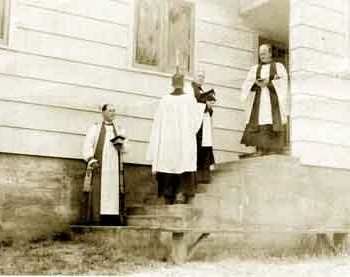
The Anglican church known today as St. Margaret of Scotland on Galiano Island began as a mission church connected to St. Mary Magdalene Anglican Church on neighbouring Mayne Island. In the early days, clergy would come by boat to serve the small congregation. Later, the community came together to build a permanent church building on land donated by the Robson family. The current church structure stands as a testament to the deep faith and collaborative spirit of Galiano residents, with many of its fixtures — including pews and the pulpit — crafted by local hands. Over the years, St. Margaret's has continued to serve not only as a place of worship but also as a gathering place for community events and fellowship.
Bambrick's Store
Bambrick's General Store
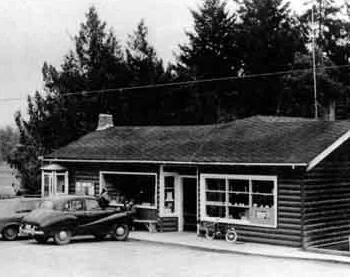
In the 1920s, Bob Bambrick's grandfather relocated his family from County Monaghan, Ireland, first settling in Victoria before seeking the quieter rural life of Galiano Island. In 1935, he purchased Heryet's Grocery Store in Sturdies Bay, establishing what would become a long-standing cornerstone of the island community. After his passing, Bob's father — who had been working as a Steam Engineer with the Canadian Pacific Railway's coastal ships — returned to Galiano to manage the store. Under the Bambrick family's stewardship, the business flourished. At one point, the family operated both the general store in Sturdies Bay on Galiano Island and another in Miners Bay on neighbouring Mayne Island. More than just a place to purchase provisions, Bambrick's General Store served as a vital gathering place and social hub — reflecting the entrepreneurial spirit and resilience of early island families.
May Days
May Days on Galiano Island
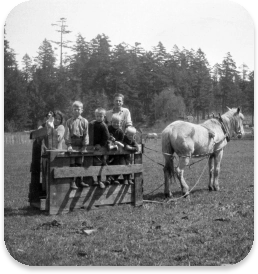
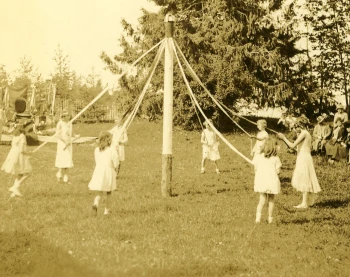
While detailed historical documentation specific to Galiano's May Day celebrations is limited online, May Day itself is a spring tradition celebrated in many parts of Canada that brings communities together to welcome the season with dances, music, and gatherings around the Maypole. On Galiano Island, May Days historically featured community-wide festivities — including girls and families celebrating around a May pole — reflecting the island's close-knit rural culture and long tradition of seasonal celebrations that mark spring's arrival. These celebrations echoed broader Canadian May Day customs, which sometimes coincide with the Victoria Day long weekend and often involve dance, flowers, and community spirit.
Wool Preparation
Wool Preparation on the Galiano Island Reserve
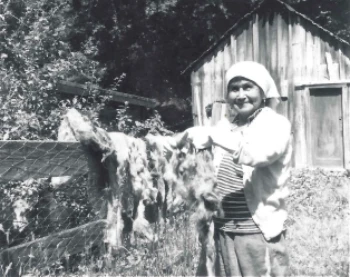
Weaving was a fundamental part of a Coast Salish woman's identity — Coast Salish women produced blankets that were central to cultural and ceremonial life, and held high status in their communities because of it. What Esther Allard is doing in this photograph is almost certainly an early step in that process: after raw fleece is washed, it must be spread out and aired to dry before it can be carded and spun. By the 1880s the Coast Salish were farming their own sheep flocks, and sheep's wool had become the primary fibre used in Salish spinning and textile work. As blanket weaving evolved through the 20th century, Coast Salish women adapted by incorporating sheep's wool into their traditional techniques. Photographed on the Galiano Reserve in 1967, Esther carried forward a tradition of craft, identity, and community that her people had maintained for generations.
The Museum's collection includes photographs that capture everyday life, community gatherings, and the evolving landscape of Galiano Island. These stories below continue to be researched and preserved.
The Best family farm
1915
Loading hay
Loading hay
Farming in the valley
Farming with oxen
Farming with oxen
Logging
Logging
Logging
Logging
Logging
Logging
Logging
Logging

Admission is by donation - Come and support!